What Is a Lathe Machine? Types, Parts, Working Principle, Operations & Industrial Applications
What Is a Lathe Machine? Types, Parts, Working Principle, Operations & Industrial Applications
A lathe machine is one of the most important machine tools used in the manufacturing and engineering industries. It is widely used to manufacture cylindrical components, shafts, bushes, threaded parts, rollers and other precision engineering components.
From small engineering workshops to large industrial manufacturing plants, lathe machines play an important role in metal cutting, component manufacturing, repair work and industrial production.
A lathe machine works by rotating the workpiece around its axis while a cutting tool moves against it to remove unwanted material and achieve the required shape, dimensions and surface finish.
Whether you are a mechanical engineer, workshop owner, production manager or industrial machinery buyer, understanding the types, parts, working principle and applications of a lathe machine can help you select the right machine for your manufacturing requirements.
In this guide, AmanJas Industries and Traders explains everything you need to know about lathe machines and their applications in modern manufacturing.
1. What Is a Lathe Machine?
A lathe machine is a machine tool used to remove unwanted material from a rotating workpiece with the help of a cutting tool. The workpiece is held in a chuck, collet or between centres and rotated by the machine spindle.
During machining, the cutting tool moves along or across the rotating workpiece to produce the required dimensions and shape.
A lathe machine is mainly used for producing components with cylindrical, conical and circular profiles. With suitable tools and attachments, it can also perform operations such as threading, drilling, boring, knurling and taper turning.
Lathe machines are commonly used for machining materials such as:
- Mild steel
- Stainless steel
- Cast iron
- Aluminium
- Brass
- Bronze
- Other machinable metals and alloys
The machine is widely known as one of the most versatile machine tools because it can perform several machining operations on a single machine.
2. Working Principle of a Lathe Machine
The working principle of a lathe machine is based on the relative movement between a rotating workpiece and a cutting tool.
Unlike a drilling machine, where the drill rotates to produce a hole, a conventional lathe machine rotates the workpiece while the cutting tool is fed against it.
The basic working process involves the following steps:
Step 1: Workpiece Mounting
The raw material or workpiece is securely held in a chuck or between the headstock and tailstock centres, depending on the job requirements.
Step 2: Spindle Rotation
The machine spindle rotates the workpiece at a selected speed. The spindle speed is selected according to the material, workpiece diameter, cutting tool and machining operation.
Step 3: Cutting Tool Positioning
The cutting tool is fixed in the tool post and positioned at the appropriate height and angle.
Step 4: Material Removal
The cutting tool is moved against the rotating workpiece. Material is removed in the form of metal chips.
Step 5: Achieving Required Dimensions
The operator controls the cutting depth, feed and spindle speed to obtain the required diameter, length, shape and surface finish.
By controlling these movements, a lathe machine can manufacture different types of precision engineering components.
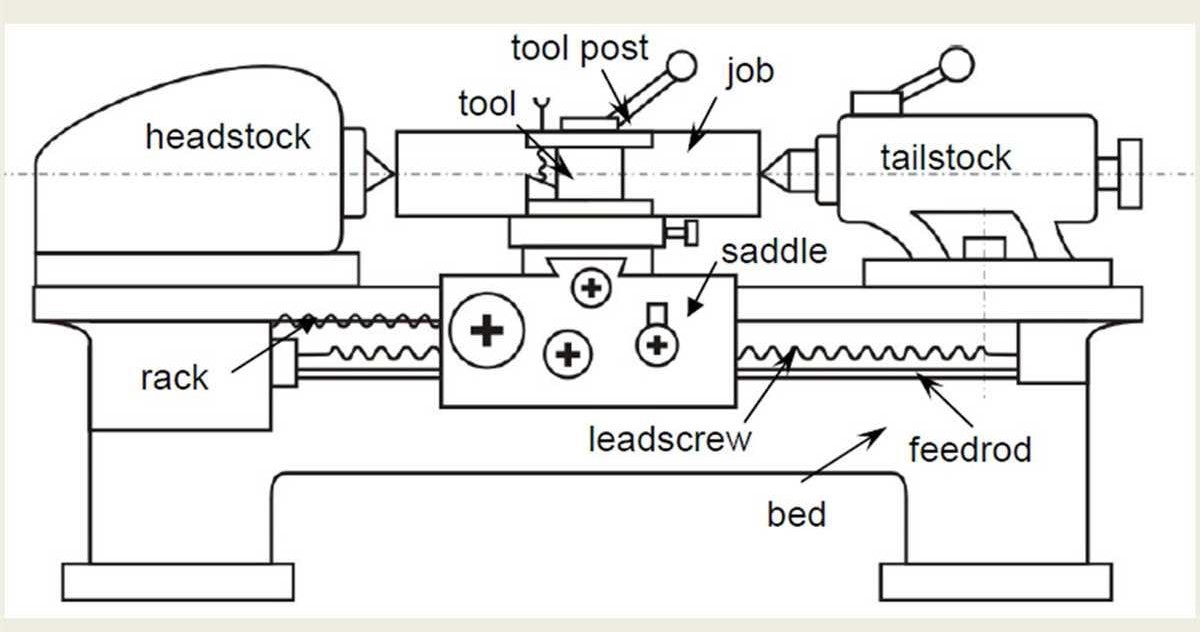
3. Main Parts of a Lathe Machine and Their Functions
Understanding the main parts of a lathe machine is important for operators, engineers and machinery buyers.
Each component performs a specific function to ensure smooth machining and dimensional accuracy.
1. Bed
The bed is the main foundation of a lathe machine. It supports the headstock, carriage and tailstock.
The bed provides rigidity and alignment to the machine. Its construction and guideway accuracy are important factors affecting machining performance.
2. Headstock
The headstock is mounted at one end of the machine bed. It houses the main spindle and the mechanism used to transmit power and control spindle rotation.
It is responsible for rotating the workpiece at the selected speed.
3. Main Spindle
The spindle is the rotating shaft of the lathe machine. It carries the chuck, faceplate or other work-holding equipment.
Its accuracy and rigidity influence the rotational performance of the machine.
4. Chuck
A chuck is a work-holding device mounted on the spindle.
It securely holds the workpiece during machining.
Common chuck types include:
- Three-jaw chuck
- Four-jaw independent chuck
- Collet chuck
- Special-purpose chuck
The selection depends on workpiece shape, size and holding requirements.
5. Tailstock
The tailstock is mounted on the bed opposite the headstock.
It is used to support long workpieces with a centre and can also hold tools such as drill bits and reamers for suitable machining operations.
6. Carriage
The carriage supports and moves the cutting tool along the machine bed.
It provides controlled movement during turning and other machining operations.
7. Cross Slide
The cross slide moves the cutting tool perpendicular to the spindle axis.
It is commonly used for facing operations and controlling the workpiece diameter.
8. Compound Rest
The compound rest is mounted on the cross slide and can be swivelled to a selected angle.
It is useful for angular machining and certain taper-turning operations.
9. Tool Post
The tool post holds the cutting tool securely in the correct position.
It allows the operator to adjust the tool according to the machining requirement.
10. Lead Screw and Feed Rod
The lead screw is primarily used to provide controlled carriage movement for thread cutting.
The feed rod transmits power for normal automatic feed movements on machines equipped with this arrangement.
11. Quick Change Gearbox
The quick change gearbox allows the operator to select different feed rates and thread pitches without manually changing multiple gears.
4. Different Types of Lathe Machines
Lathe machines are available in different designs and configurations. Each type is developed to meet particular machining, production and accuracy requirements.
1. Centre Lathe Machine
A centre lathe, also commonly called an engine lathe, is a versatile general-purpose machine used for various machining operations.
It is suitable for turning, facing, boring, threading, taper turning and other workshop applications.
Centre lathe machines are widely used in engineering workshops, maintenance departments and manufacturing plants.
2. Heavy Duty Lathe Machine
Heavy duty lathe machines are designed for machining large-diameter, long or heavy workpieces.
They are used in applications where machine rigidity, suitable spindle capacity, motor power and workpiece support are important.
Typical applications include machining heavy shafts, rollers, industrial components and large engineering jobs.
3. CNC Lathe Machine
A CNC lathe machine uses a computer numerical control system to control machining movements.
The machine follows programmed instructions to perform turning operations with repeatability and reduced manual intervention.
CNC lathes are commonly used in production environments requiring consistent component dimensions and repetitive machining.
4. Turret Lathe Machine
A turret lathe is designed for repetitive machining operations.
It uses a turret arrangement that holds multiple tools, allowing different machining operations to be carried out in sequence.
It is particularly useful for batch and production manufacturing.
5. Tool Room Lathe Machine
A tool room lathe is designed for precision machining applications.
It is commonly used in tool rooms, maintenance workshops and manufacturing facilities where accurate machining and a wider range of operations are required.
6. Bench Lathe Machine
A bench lathe is a relatively compact machine mounted on a workbench or stand.
It is generally used for small components, light machining and precision work.
7. Special Purpose Lathe Machine
Special purpose lathe machines are designed for specific manufacturing requirements and particular types of components or operations.
Their design, tooling, work-holding arrangement and automation can be developed according to the production requirement.
5. Common Operations Performed on a Lathe Machine
A lathe machine can perform several machining operations depending on its design, attachments and tooling.
The most common operations include:
1. Turning
Turning is the basic lathe operation in which material is removed from the outer surface of a rotating workpiece to reduce its diameter and produce a cylindrical shape.
2. Facing
Facing is used to produce a flat surface at the end of a workpiece.
The cutting tool moves across the face of the rotating component.
3. Taper Turning
Taper turning produces a conical surface by gradually changing the diameter of the workpiece along its length.
4. Thread Cutting
Thread cutting is used to produce external or internal threads on a component using suitable tooling and machine settings.
5. Drilling
Drilling on a lathe is performed by holding a drill in the tailstock or a suitable tool-holding arrangement while the workpiece rotates.
It is commonly used to produce holes along the workpiece axis.
6. Boring
Boring is an operation used to enlarge or finish an existing hole to the required diameter and surface quality.
7. Knurling
Knurling produces a patterned surface on a workpiece to improve grip or provide a specific surface appearance.
8. Parting-Off
Parting-off is used to cut a finished component from the remaining workpiece using a suitable cutting tool.
9. Grooving
Grooving creates a narrow recess or channel on the external or internal surface of a component.
6. Industrial Applications of Lathe Machines
Lathe machines are used in several industries because of their ability to manufacture and repair different types of engineering components.
Some important industrial applications include:
Automobile Industry
Lathe machines are used to manufacture and repair shafts, bushes, spacers, threaded components and other automotive parts.
Steel and Metal Processing Industry
They are used for machining rollers, shafts, pins and other components used in industrial machinery and production equipment.
Sugar Mill Industry
Lathe machines are used in maintenance workshops for machining shafts, rollers, bushes and other mechanical components required for sugar mill equipment.
General Engineering Workshops
They are commonly used for job work, component manufacturing, repair and maintenance activities.
Heavy Engineering Industry
Heavy duty lathe machines are used for machining large and heavy components such as industrial shafts, rollers and cylindrical machine parts.
Manufacturing and Fabrication Units
Lathe machines support component development, machining, finishing and maintenance activities.
7. Important Lathe Machine Specifications to Check Before Buying
Selecting the right lathe machine is important for achieving the required machining performance and production efficiency.
Before purchasing a lathe machine, consider the following specifications.
1. Swing Over Bed
Swing over bed indicates the maximum diameter of a workpiece that can rotate above the bed without interference.
It is one of the most important specifications when selecting a lathe machine.
2. Swing Over Cross Slide
This indicates the maximum workpiece diameter that can rotate above the cross slide.
It is generally smaller than the swing over bed.
3. Distance Between Centres
Distance between centres indicates the maximum length of a workpiece that can be accommodated between the headstock and tailstock centres.
Choose a suitable length according to your job requirements.
4. Spindle Bore
Spindle bore indicates the internal diameter of the spindle opening.
It is important when machining long bars or shafts that need to pass through the spindle.
5. Spindle Speed Range
Spindle speed determines how fast the workpiece rotates.
The required speed range depends on the workpiece material, diameter, cutting tool and machining operation.
6. Motor Power
Motor power affects the machine's ability to perform machining operations under different cutting loads.
The required motor capacity should be selected according to the material, cutting conditions and production requirements.
7. Machine Bed and Overall Rigidity
A rigid machine structure helps control vibration and deflection during machining.
The bed, guideways and overall machine construction are important considerations when evaluating a lathe machine.
8. Required Accuracy
The required machining accuracy depends on the component drawing, tolerance, surface finish and manufacturing application.
Discuss the actual job requirements with the machine manufacturer before finalising the machine.
8. How to Choose the Right Lathe Machine for Your Workshop?
Buying an industrial lathe machine is an important investment. The correct selection depends on the type of work, component dimensions, material and production requirements.
Consider these important factors before making a purchase:
- Workpiece diameter: Identify the maximum diameter of the components you need to machine.
- Workpiece length: Select a suitable distance between centres.
- Material type: Consider whether you will machine mild steel, cast iron, stainless steel or other materials.
- Machining operations: Identify whether you need turning, facing, threading, boring or other operations.
- Required accuracy: Check the dimensional tolerance and surface finish required for your jobs.
- Production quantity: Consider whether the machine will be used for job work, batch production or continuous manufacturing.
- Machine capacity: Evaluate spindle speed, motor power, spindle bore and machine rigidity.
- Manufacturer support: Check the availability of technical assistance, spare parts and after-sales service.
A machine should always be selected according to the actual machining requirements rather than only its price or overall size.
9. Difference Between Conventional Lathe and CNC Lathe Machine
Both conventional and CNC lathe machines are used for turning operations, but their working methods and applications are different.
| FeatureConventional LatheCNC Lathe | ||
| Operation | Mainly manual control | Computer-controlled |
| Programming | Not normally required | Required |
| Operator involvement | Higher | Lower during automatic cycles |
| Production | Suitable for job work and varied operations | Suitable for repeat production |
| Initial investment | Generally lower | Generally higher |
| Flexibility | Flexible for manual machining | Flexible through programmed operations |
The correct choice depends on production quantity, component complexity, required accuracy, budget and available technical expertise.
A conventional lathe remains a practical choice for many engineering workshops, maintenance departments and industrial machining applications.
10. Maintenance Tips for Better Lathe Machine Performance
Regular maintenance helps maintain machine performance and reduce unnecessary breakdowns.
Some important maintenance practices include:
- Clean the machine bed and guideways regularly.
- Follow the manufacturer's lubrication schedule.
- Check the condition of spindle bearings and drive components.
- Inspect belts, gears and feed mechanisms.
- Keep the chuck and work-holding devices clean.
- Check machine alignment when required.
- Inspect cutting tools and replace damaged or worn tools.
- Maintain proper coolant levels where applicable.
- Avoid operating the machine beyond its recommended capacity.
- Follow the machine manufacturer's maintenance instructions.
Regular inspection and proper operation help improve machine life and maintain consistent machining performance.
11. Frequently Asked Questions About Lathe Machines
Q1. What is a lathe machine used for?
A lathe machine is used to manufacture cylindrical and other rotational components through material removal. Common operations include turning, facing, taper turning, threading, drilling, boring and knurling.
Q2. What is the working principle of a lathe machine?
A lathe machine works by rotating the workpiece while a cutting tool is fed against it to remove unwanted material and achieve the required dimensions and shape.
Q3. What are the main parts of a lathe machine?
The main parts include the bed, headstock, spindle, chuck, tailstock, carriage, cross slide, compound rest, tool post, lead screw and feed rod.
Q4. Which types of lathe machines are commonly used in industries?
Common types include centre lathes, heavy duty lathes, CNC lathes, turret lathes, tool room lathes, bench lathes and special purpose lathes.
Q5. What is the difference between turning and facing?
Turning reduces the external diameter of a rotating workpiece by moving the cutting tool along its axis. Facing produces a flat surface at the end of the workpiece by moving the tool across its face.
Q6. How do I select the right lathe machine?
Consider swing over bed, swing over cross slide, distance between centres, spindle bore, spindle speed, motor power, material type and required machining accuracy.
Q7. Which lathe machine is suitable for heavy industrial jobs?
A heavy duty lathe machine with suitable swing capacity, centre distance, spindle capacity, motor power and machine rigidity is generally considered for heavy industrial machining. The final selection depends on the actual workpiece and machining requirements.
Q8. Can a lathe machine be customised according to job requirements?
Yes. Depending on the machine design and manufacturing feasibility, specifications such as centre distance, swing capacity, spindle bore, spindle speed and other features can be configured to suit specific applications.
12. Choose the Right Lathe Machine with AmanJas Industries and Traders
A lathe machine is an important investment for any engineering workshop or industrial manufacturing unit. Selecting the right machine according to workpiece dimensions, material, machining operations and accuracy requirements is essential for reliable machining performance.
AmanJas Industries and Traders is an industrial machinery business based in Batala, Punjab, India, offering machine tools and engineering machinery solutions for industrial and manufacturing requirements.
We understand that different industries and workshops have different machining requirements. Therefore, selecting a machine according to the actual job specifications is important.
Whether you require a conventional lathe machine, heavy duty lathe machine or a machine configured according to your specific application, our team can discuss your requirements and suggest a suitable machine configuration.
Looking for a Lathe Machine for Your Workshop or Manufacturing Plant?
Share your required swing over bed, distance between centres, spindle bore, material type and machining requirements with our team.
Contact AmanJas Industries and Traders for machine specifications, customised requirements and quotations.
AmanJas Industries and Traders
Batala, District Gurdaspur, Punjab, India – 143505
Website: https://amanjas.com
Tagline: Advance Machinery for Bright Future.
>
Get a Quote
Fill in your details and our team will get back to you shortly.
Chat with us!
Typically replies instantly
Welcome to our site, if you need help simply reply to this message, we are online and ready to help.