
Lathe Machine Price in India 2026: Complete Buying Guide
January 14, 2026
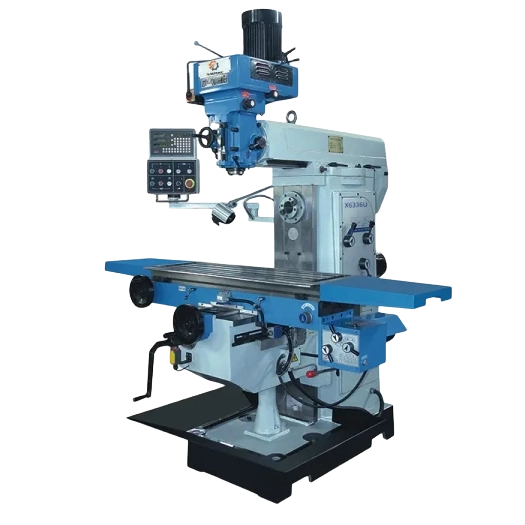
Milling machines are among the most versatile and essential tools in any machining workshop. They can perform operations ranging from simple slot cutting and facing to complex contour milling, gear cutting, and die-sinking — all with high precision and repeatability. But with so many types available, choosing the right milling machine for your specific needs can be a challenge.
This guide walks you through the key types of milling machines, their respective strengths, and the critical factors to evaluate before making a purchase decision.
The universal milling machine is the most versatile option in any workshop. It features a swiveling table and an adjustable head that can be tilted for angular and helical milling operations. This flexibility makes it ideal for workshops that handle diverse machining tasks — from straight slotting and face milling to gear cutting and compound angle work.
Our Universal Milling Machine is engineered with a robust column and knee construction, precision-ground guideways, and a wide speed range to handle both light-duty and demanding milling operations.
In a vertical milling machine, the spindle axis is perpendicular to the worktable. The cutting tool moves up and down along the spindle axis while the workpiece moves on a reciprocating horizontal table. This configuration is ideal for:
Vertical mills offer excellent visibility of the cutting area, making them well-suited for operations that require frequent tool-path adjustments.
Horizontal milling machines position the spindle parallel to the worktable. They are purpose-built for heavy-duty operations:
The horizontal spindle orientation provides better chip evacuation and supports the use of rigid arbor-mounted cutters — making these machines the workhorses of production environments.
Bed type milling machines feature a fixed worktable mounted on a rigid bed, with the spindle head moving vertically on column ways. Their construction is more rigid than knee-type machines, making them suitable for heavy-duty, high-precision production work. The fixed table eliminates the deflection associated with movable knee designs.
Turret milling machines feature a stationary spindle and a movable turret head that can be swung and tilted into virtually any position. This flexibility allows for complex angular milling, making them a popular choice for tool rooms and general-purpose machining. They're particularly effective when you need to machine multiple features on a single workpiece without repositioning.
Regardless of type, these are the critical parameters to evaluate:
The table dimensions and X/Y/Z axis travels determine the maximum workpiece size you can handle. Consider not just your current parts but also potential future requirements. A larger table gives you more flexibility without the need to upgrade later.
Spindle speed determines the range of materials and operations you can perform. Wider speed ranges (e.g., 50–3000 RPM) allow you to machine everything from large steel forgings to small aluminium components. Spindle power (HP) determines the depth of cut and material removal rate you can achieve.
The spindle taper (commonly IS 40, IS 50, or NT40) determines tool compatibility. Ensure the taper matches your existing tooling or budget for new tooling. IS 40 and IS 50 are the most common standards in Indian industrial machinery.
Milling accuracy depends heavily on machine rigidity. Look for:
If you're scaling production volumes, consider machines that can be retrofitted with CNC controls. Many conventional milling machines serve as excellent platforms for CNC conversion, offering a path to automation without replacing the entire machine.
A milling machine is a long-term investment. Ensure your supplier provides:
The best milling machine for your operation depends on your specific requirements — the materials you machine, the parts you produce, the volumes you run, and your budget. If you primarily work on small to medium-sized general engineering parts, a Universal Milling Machine offers the best combination of versatility and value. For heavy production environments, a bed type or horizontal mill may be the better investment.
At Amanjas, our team can help you assess your requirements and recommend the right machine. We manufacture a comprehensive range of milling machines backed by ISO 9001:2015 certified quality standards and a nationwide service network. Contact us to discuss your needs.
Fill in your details and our team will get back to you shortly.
Chat with us!
Typically replies instantly
Welcome to our site, if you need help simply reply to this message, we are online and ready to help.